Choosing a membrane system is rarely as simple as comparing two specification sheets. Plant teams have to think about feedwater quality, the contaminants that actually need to be removed, the quality of water required downstream, recovery targets and operating costs. At Ion Exchange, these factors are considered together because the wrong membrane choice can create problems well beyond water quality. When evaluating ultrafiltration vs reverse osmosis, the more useful question is not which technology is better, but which separation job your plant needs the membrane to perform.
That distinction matters. Ultrafiltration and RO may both sit inside a membrane filtration system, but they solve very different water treatment problems. In fact, many well-designed industrial systems use them together rather than choosing one instead of the other.
Ultrafiltration vs Reverse Osmosis: What Is the Real Difference?
The simplest way to understand the difference between ultrafiltration and reverse osmosis is to look at what passes through the membrane.
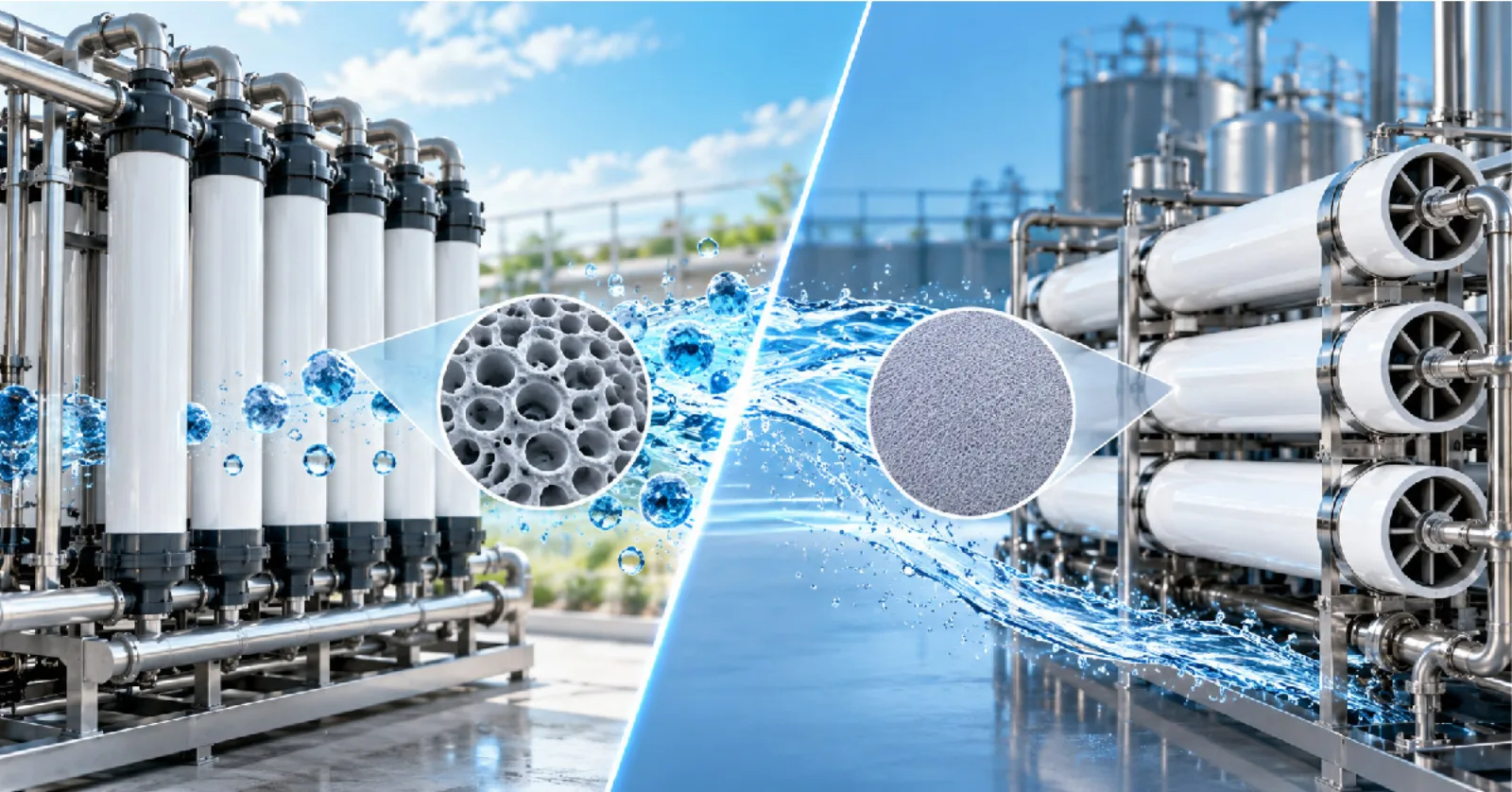
Ultrafiltration focuses on contaminants such as colloids, suspended particles, bacteria and larger organic molecules based on their size whether they’re dissolved or not. Water that has gone through ultrafiltration has a very low turbidity and is usually treated for clarification, recycling and prior membrane treatment processes. The UF membranes that are commercially used for water treatment are usually designed to separate macromolecules and fine particles.
In a nutshell, reverse osmosis processes water at a much smaller scale. Reverse osmosis mainly deals with dissolved contaminants rather than the suspended ones. Depending on the specific type of membranes, system design and operational conditions, reverse osmosis can reject 95 to 100% of dissolved salts.
Thus, ultrafiltration is used in situations where the main problem is solids or turbidity, while reverse osmosis is important in cases when one needs to lower total dissolved solids and conductivity levels in water..
How Does Ultrafiltration Work?
Ultrafiltration uses a pressure-driven membrane to separate fine suspended contaminants from water. Water and smaller dissolved substances pass through, while larger particles and microorganisms are retained.
From the operational standpoint, often, UF offers a significant advantage in that it operates under much lower pressures than the majority of RO systems. That usually enables UF to be chosen when taking care of dissolved salt removal is not the primary objective.
An example could be the plant withdrawing surface water with variable turbidity due to heavy rainfall. Delivering this unstable feed directly to sensitive downstream operations may result in increased cleaning frequency and poor process stability. Employing a UF stage would help to deliver a much more stable feed.
That is why UF is commonly used upstream of RO installations. Good pretreatment helps to get rid of a large part of particles and colloids that would otherwise affect the operation of the RO membrane and might lead to its fouling and the necessity of frequent cleaning.
How Does Reverse Osmosis Work?
RO uses pressure to move water through a semi-permeable membrane while retaining dissolved contaminants. The process produces two streams: purified permeate and a concentrated reject stream.
The advantage lies in their capacity to reduce dissolved substances.
When it comes to boilers, electronic engineering, manufacturing or recycle of sewage, usually only the visible impurities are removed. The problem is that dissolved salts, hardness components, silicates and other substances affect machinery and quality of finished products. That is real use of reverse osmosis.
The disadvantage is that reverse osmosis requires increased pressure to be applied, proper pretreatment, and careful monitoring of scaling and fouling. Recovery has to be engineered, but not just maximized.
UF vs RO at a Glance
| Consideration | Ultrafiltration | Reverse Osmosis |
|---|---|---|
| Main purpose | Remove suspended and colloidal contaminants | Reduce dissolved salts and dissolved contaminants |
| Typical targets | Turbidity, suspended solids, bacteria, colloids | TDS, conductivity, dissolved ions and salts |
| Operating pressure | Lower | Higher |
| Dissolved salt removal | Limited | High |
| Common role | Clarification, reuse, RO pretreatment | Desalination, process water, reuse, high-purity applications |
| Reject/concentrate | Usually lower dissolved-load concentration concern | Concentrated reject stream requires management |
| Combination potential | Frequently installed upstream of RO | Frequently benefits from effective UF pretreatment |
The table makes ultrafiltration vs reverse osmosis for water treatment appear straightforward, but real plant selection should go deeper than contaminant size alone.
Which Membrane Should Your Plant Choose?
Start with the treated-water specification, not with the equipment.
Choose UF when particulate removal is the main concern
UF can be a strong fit when the plant needs to control turbidity, suspended solids, colloids or microbial contamination while retaining most dissolved minerals.
It is also worth considering when feedwater conditions fluctuate. A reliable UF barrier can make downstream treatment more predictable.
Choose RO when dissolved solids must come down
If conductivity, salinity or TDS is the limiting parameter, UF alone cannot deliver the required separation. RO is generally the more appropriate membrane process.
This often applies to industrial process water, boiler feed pretreatment, desalination and wastewater reuse applications where water must meet a tighter chemical specification.
Use UF and RO together when the feed demands both
That is often the misconception that arises in a simple ultrafiltration vs. reverse osmosis comparison.
Plants that treat difficult surface water or wastewater may be presented with both suspended impurities as well as dissolved salts. If one membrane step is forced to do both tasks, some compromise is likely necessary.
Applying UF in advance will help to reduce the suspended and colloidal material before RO can deal with dissolved solids..
Look Beyond the Membrane Purchase Price
Membrane selection should be based on lifecycle performance rather than equipment cost alone.
What will take place when the level of turbidity in the water changes? After how much time will the membranes be cleaned? Will there be a risk of scaling? What recovery percentage can be expected? Which is the best way to dispose of the RO concentrate? Is it possible to use treated water?
These questions will influence usage of chemicals, energy, membrane life, downtime, and operator involvement.
A membrane configuration that is cheap, but requires frequent work may incur greater costs over time in comparison with a correctly implemented treatment system.
How Ion Exchange Approaches Membrane Treatment
Ion Exchange is not a company that merely offers membrane technology; rather, it integrates it with water chemistry and pretreatment, wastewater treatment and water reuse technologies. Its range of products includes such membranes as HYDRAMEM reverse osmosis, ultrafiltration and nanofiltration membranes, as well as plants for water and wastewater treatment. In addition, Ion Exchange provides various membrane-related chemicals, services related to operation and maintenance of membranes and auditing.
The specialists of Ion Exchange utilize even INDION PF/DT reverse osmosis systems for those cases when difficult wastewater is to be cleared. This technique participates in Zero Liquid Discharge process and water recovery processes.
This wider approach is essential. The performance of membranes is influenced by all previous and subsequent processes that take place before and after them.
Choose the Treatment Train, Not Just the Membrane
The decision around ultrafiltration vs reverse osmosis ultimately comes back to two things: what is present in the incoming water, and what quality must come out of the plant.
UF makes sense when suspended material, colloids and microorganisms are the primary challenge. RO is required when dissolved salts and higher-purity water become the priority. And when both challenges exist, combining the technologies can be far more effective than treating them as alternatives.
Planning a new water treatment, wastewater recycling or process-water system? Talk to Ion Exchange about your feedwater conditions, reuse targets and operating requirements to develop a membrane treatment strategy built around your plant—not around a generic equipment specification.
Frequently Asked Questions
1. What is the main difference between ultrafiltration and reverse osmosis?
UF is mainly suited for the removal of suspended solids, as well as bacteria, coloids and larger molecules, while RO can remove a higher percentage of dissolved salts and ions. The choice of process should hence depend on the type of contaminant and the desired treated-water quality.
2. Is ultrafiltration better than RO for water treatment?
Neither is universally better. For ultrafiltration vs reverse osmosis for water treatment, UF is typically preferred for particulate and microbial control, while RO is suited to dissolved-solids reduction and higher-purity applications.
3. Can ultrafiltration remove TDS from water?
UF does not significantly remove dissolved salts because these substances are small enough to pass through conventional UF membranes. Where substantial TDS reduction is required, RO or another dissolved-ion treatment process is generally needed.
4. Does RO need ultrafiltration before it?
Ultrafiltration (UF) is not required for every Reverse Osmosis (RO) system, but UF may be used effectively as a pretreatment method when the water has large suspended solids, colloidal substances and changing turbidity. When designing a treatment system, consideration must be given to actual analysis on the raw water.
5. Can UF and RO be used in the same treatment plant?
Yes. Combining UF with RO is common in membrane filtration systems handling challenging feedwater. UF can control suspended and colloidal contaminants before RO removes dissolved salts, creating a more robust overall treatment train.