

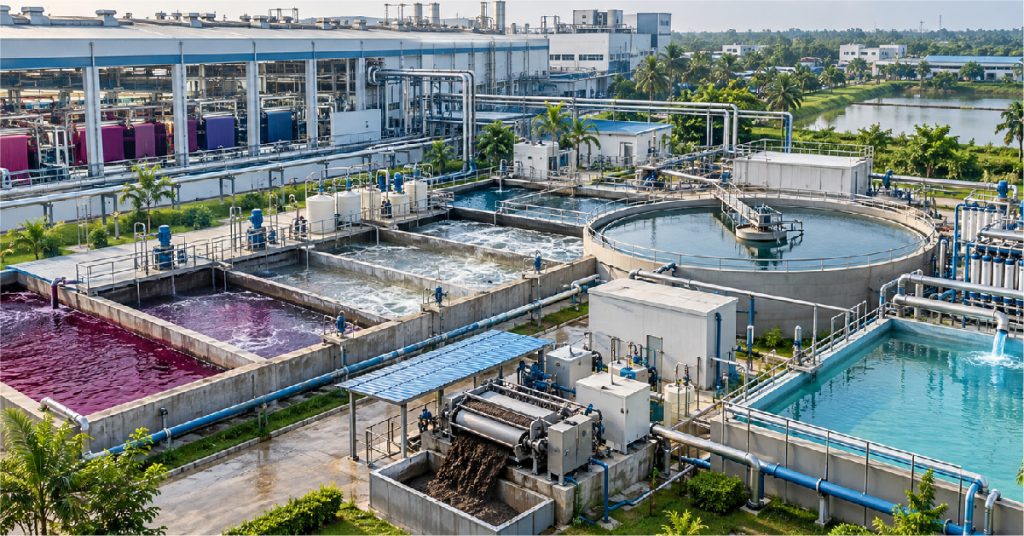
Bangladesh’s textile and ready-made garment sector is the backbone of the country’s export economy. In FY2024–25, ready-made garments alone contributed about 81.5% of Bangladesh’s total merchandise exports. But behind every dyeing, washing, printing and finishing operation is another reality: wastewater loaded with dyes, chemicals, salts, suspended solids and organic contaminants.
That makes choosing the right ETP Plant more than an environmental decision. A poorly designed system can struggle to meet discharge requirements, increase operating costs and eventually affect production continuity and buyer confidence.
For textile manufacturers evaluating industrial ETP plant solutions in Bangladesh, the right question is not simply, “What capacity should we buy?” It is, “What system can reliably treat our actual wastewater today and still work when production changes tomorrow?”
Why Textile Factories in Bangladesh Need an ETP Plant
Textile manufacturing is often accompanied by the production of wastewater that must be treated before it is disposed. The Environmental Conservation Rules, 2023, is the current legal framework in Bangladesh that oversees compliance through the Department of Environment.
Compliance, however, is only one factor to consider as apparel businesses have begun to face scrutiny from international clients regarding their environmental performance, including water usage and wastewater management practices across the supply chain.
A reliable ETP plant for textile industry in Bangladesh therefore protects more than the environment. It helps protect production continuity, customer relationships and long-term licence to operate.
This is why DOE-compliant textile wastewater treatment should be designed around actual effluent characteristics rather than a standard package offered to every factory.
Types of Wastewater Generated in Textile Processing
A textile wastewater treatment plant has a difficult job because textile effluent changes considerably between production stages.
Key Pollutants at Each Textile Production Stage
| Production Stage | Common Pollutants | Treatment Challenge |
| Pre-treatment & bleaching | Alkalis, peroxide, surfactants, suspended solids | High pH and variable organic load |
| Dyeing | Dyes, salts, auxiliaries, metals, high COD | Colour and dissolved contaminants |
| Printing | Pigments, binders, solvents, chemicals | Complex chemical composition |
| Finishing | Softeners, resins, oils and additives | Residual organics and chemicals |
Ion Exchange notes that textile wastewater can require combinations of biological, chemical, membrane and advanced recovery technologies depending on the treatment objective.
That is precisely why an ETP plant for textile factory applications should begin with wastewater characterisation.
7 Key Factors to Choose the Right ETP Plant for Textile Industry
Before signing a contract with an ETP supplier in Bangladesh, evaluate these seven factors.
1. Daily Effluent Volume and Flow Rate
Start with how much wastewater your factory actually generates.
Measure average flow, peak hourly discharge and variations between production shifts. Then consider planned production expansion. An ETP designed exactly around today’s average flow may become undersized as soon as another dyeing line is added.
The best industrial ETP plant in Bangladesh should therefore include sensible peak-flow and future-capacity allowances.
2. Type of Treatment Technology Required
The textile treatment process is not true for every manufacturer.
The usual techniques embraced in textile treatments include physical treatments like sieving and balancing, chemical treatments such as coagulation and flocculation, biological treatment for BOD and COD removal, and tertiary polishing done when needed.
In cases where their customers want the treated water to get reused or achieve the better results, the manufacturers have to work with advanced technologies like ultrafiltration, reverse osmosis, membrane bioreactor or Zero Liquid Discharge processes. Ion-exchange methods include membrane technologies, effluent recycling and ZLD solutions.
Technology should follow wastewater chemistry — not the other way around.
3. DOE Compliance and Discharge Standards
Your system must be designed around the discharge or reuse quality required for the facility.
Parameters such as pH, BOD, COD, suspended solids and colour can determine treatment design. Installing equipment first and checking compliance later is an expensive way to discover that additional treatment stages are needed.
A professional textile effluent treatment plant Bangladesh project should therefore establish influent characteristics and target outlet quality before process design begins.
4. Supplier Experience and Track Record
Ask potential suppliers a simple question: “Where have you treated wastewater similar to ours?”
Hence, waste from textile wet-processing activities creates wastewater that cannot be released without proper treatment. The environmental regulatory system in Bangladesh now has Environmental Conservation Rules 2023 which are implemented by the Department of Environment.
Ensuring compliance is not the it for manufacturers. International clothing buyers consider various aspects concerning environmental performance, water usage and wastewater treatment in their supply chain.
5. Total Cost of Ownership, Not Just Installation Price
The lowest quotation is rarely automatically the lowest-cost plant.
Evaluate electricity consumption, chemicals, membranes, sludge handling, manpower, replacement parts, laboratory testing and preventive maintenance over several years.
Published research covering Bangladesh textile facilities found installation costs varied dramatically according to capacity, technology and site conditions, reinforcing why simple market-price comparisons can be misleading.
Build a five-year cost model before comparing suppliers.
6. After-Sales Service and Maintenance Support
Even a well-designed effluent treatment system for textile industry can underperform when aeration equipment, dosing systems, membranes or instrumentation are poorly maintained.
Ask who provides commissioning support, operator training, preventive maintenance and emergency service. Also clarify spare-part availability and service response expectations before awarding the contract.
Ion Exchange Bangladesh states that its installations are supported by trained service engineers and 24×7 service capabilities.
7. Scalability and Water Reuse Potential
Forward-looking factories should ask another question: can treated water become a resource?
An advanced textile wastewater treatment plant can incorporate UF, RO and other polishing processes so suitable treated water can be reused for selected process or utility applications.
For facilities pursuing very high recovery, ZLD and water reuse solutions for textile factories can further reduce liquid discharge. Ion Exchange offers complete ZLD and near-ZLD solutions for textile operations.
Common Mistakes Textile Factories Make When Buying an ETP
The most significant blunder is making purchases based solely on capital cost. Other miscalculations involve incorrectly sizing the capacity, not considering peak demands, neglecting sludge treatment and assuming that the outlet-water guarantee from each supplier also means that there will be compliance with the law.
A common mistake occurs when one does not carry out trials with some sample sewage before selecting the tech.
A good ETP plant for textile factory operations should be engineered from data rather than assumptions.
ETP Plant Cost Estimate for Textile Industry in Bangladesh
ETP costs vary too widely for one standard price to be meaningful. Bangladesh research has documented installation costs ranging from roughly BDT 2 million to BDT 60 million among surveyed textile facilities, depending on plant size and configuration.
| Requirement | Typical Cost Impact |
| Small conventional system | Lower capital requirement |
| Chemical + biological treatment | Moderate investment |
| Large industrial plant | Higher civil and equipment cost |
| MBR / UF / RO reuse system | Higher technology investment |
| ZLD system | Highest capital and energy requirement |
Always request an itemised quotation covering civil works, electromechanical equipment, automation, sludge management, commissioning and operating consumables.
Why Ion Exchange Is a Trusted ETP Partner for Textile Industries
Ion Exchange has established a strong presence in Bangladesh with the help of Ion Exchange Environment Management (BD) for over 30 years. The company offers a range of services such as water and wastewater treatment, industrial effluent treatment, membrane systems, chemicals for treatment, resins, and operational support in Bangladesh.
For textile manufacturers, that integrated capability matters. Instead of treating an effluent treatment system for textile industry as isolated equipment, Ion Exchange can address treatment, recycling, membranes, consumables, ZLD and ongoing service within a broader water-management strategy.
Make the Right ETP Plant Decision for Your Industry
Choosing an ETP Plant should begin with wastewater characteristics, production capacity and regulatory requirements, followed by technology, lifecycle cost, service support and future reuse plans.
The right ETP plant for textile industry in Bangladesh is not simply a compliance investment. It can support reliable production, reduce environmental risk, improve water efficiency and prepare the facility for increasingly demanding sustainability expectations.
Speak with Ion Exchange Bangladesh for an ETP feasibility consultation and identify the treatment configuration best suited to your factory’s actual wastewater and production requirements.
Frequently Asked Questions About ETP Plants for Textile Industry
Is an ETP plant mandatory for textile factories in Bangladesh?
Industrial wastewater generation by textile wet-processing plants should be in line with Department of Environment clearance and effluent regulations. The treatment configuration needed will vary according to the processes carried out by the plant and the wastewater characteristics.
What capacity ETP does a textile dyeing factory need?
Capacity should be based on measured daily wastewater generation, peak hourly flow, production shifts and future expansion. It should not be calculated only from current average production.
Can ETP-treated water be reused in textile production?
Yes. Depending on the required reuse quality, tertiary treatment technologies such as filtration, UF and RO can further treat effluent for suitable process or utility applications.
How do I choose between a conventional ETP and an MBR system?
Conventional systems may suit facilities with adequate space and suitable effluent characteristics. MBR can offer compact footprints and high-quality treated effluent where space or reuse requirements are important. Ion Exchange Bangladesh offers MBR solutions for industrial and municipal wastewater applications.
What should I ask an ETP supplier before signing a contract?
Request the process design basis, inlet and outlet parameters, guaranteed treatment capacity, equipment specifications, utility requirements, operating-cost estimates, sludge-management approach, project references, commissioning scope, warranty and after-sales service commitments.