

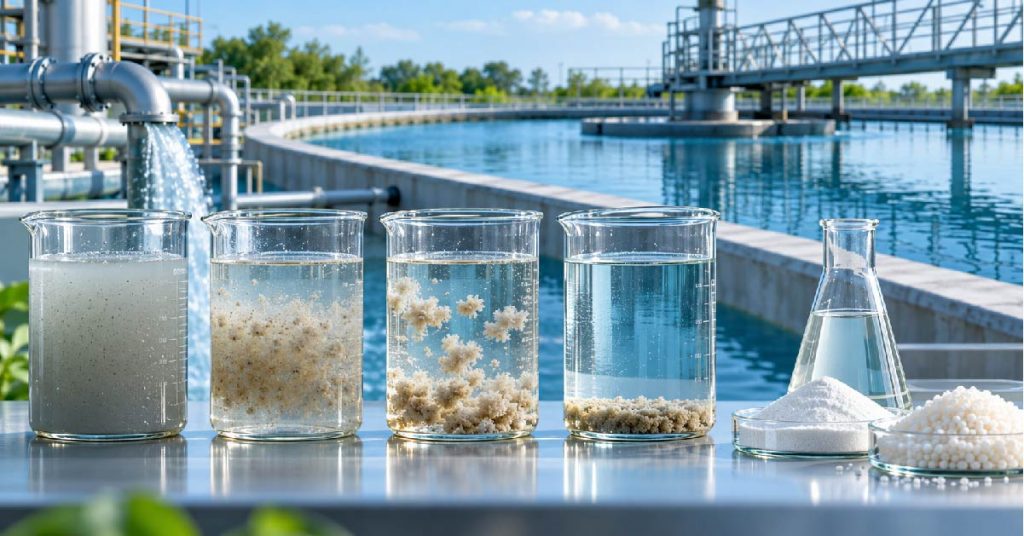
A treatment plant rarely moves from stable operation to poor performance overnight. The warning signs tend to appear gradually. Settling takes longer. Clarifier overflow is not as clear as it used to be. Filters need attention more often, or sludge that was easy to handle suddenly becomes troublesome.
Normally, one would start off by checking pumps, flow rates and mechanical equipment. But many times, it is equally important to check the chemistry. It could be that the wastewater is different but the treatment programme is unchanged.
This is the challenge with the usage of flocculants in water treatment. There is no universal polymer for all streams of water and wastewater. The right choice is the one that fits the actual conditions in the treatment plant.
What Really Happens During Flocculation?
Flocculation in water treatment helps very small particles gather into larger masses, or flocs, that are easier to separate from water.
At this point in the process, coagulation has performed the first step of the task of causing destabilization of the particles. Flocculation is mainly responsible for allowing those particles to come in contact with and unite each other.
This is where one can see the close relationship between coagulants and flocculants although it has to be pointed out that these two terms should not be considered the equivalent. The flocculant cannot turn around the situation if the coagulation process failed.
Mixing is another issue to pay attention to. The amount of agitation of the water is important not only for its getting particles together, but too much mixing will break the formed flocs. In their guidelines, WHO mentions the dosage of the chemicals and other factors that can help with performance of coagulation and flocculation processes.
Understanding the Main Types of Flocculants
Broadly, the common types of flocculants used in treatment plants are anionic, cationic and non-ionic polymers. Knowing the category is useful, but it is only a starting point.
Anionic Flocculants
Anionic polymers carry a negative charge. They are commonly considered where mineral solids, precipitated metals or metal hydroxide flocs are part of the wastewater.
In many treatment programmes, an anionic polymer is used after coagulation to help smaller solids build into flocs that settle more readily. The exact response, however, depends on the wastewater chemistry and the polymer characteristics.
Cationic Flocculants
Cationic polymers carry a positive charge. They can work particularly well with negatively charged organic solids, which is why they are frequently associated with sludge conditioning and biological solids separation.
There is an important caveat here. “Cationic” is not a complete product specification. Charge density and molecular weight vary considerably. A polymer that performs well in one sludge stream may behave quite differently in another.
Non-Ionic Flocculants
Non-ionic polymers have little or no ionic charge. Their effect relies more on physical bridging between particles than on strong electrostatic attraction.
They can be appropriate where highly charged chemistry is unnecessary or where a neutral polymer gives better separation.
These types of flocculants should therefore be viewed as families of chemistry, not ready-made answers to a treatment problem.
How Should Flocculants in Water Treatment Be Selected?
Start with the water instead of the product catalog.
What is being removed? A fine material like clay will not react in the same way as biological sludge. Oily solids, metals in the presence of other substances, and other materials act differently.
The next step is to check pH. Coagulation reaction is heavily dependent on water chemistry or pH conditions upstream. Poor pH conditions upstream may cause weak floc.
According to WHO recommendations, coagulant dose and pH must be determined through jar tests and repeated often enough to adjust to changing raw-water conditions.
Then comes the practical observation and one should monitor the floc produced.
Does floc come out quickly? Does it settle at a reasonable speed? Is the settled material compact or loose? Does floc maintain its integrity while flowing towards the clarification process?
A big beautiful floc in a laboratory beaker doesn’t mean that everything is alright. If it breaks apart in the plant or produces problematic sludge in the future, the process has really not helped solve the issue.
Jar Testing: Simple, but Still Valuable
Jar testing is hardly sophisticated technology, yet it remains one of the most useful tools for comparing flocculant chemicals.
Rather than looking only for the clearest water, operators should note several things at once: how fast the floc appears, how quickly it settles, how much sludge forms and what dose was required to achieve the result.
The test becomes even more useful when water quality varies. A textile plant changing production batches, for example, may see a very different effluent profile from one day to another. Seasonal changes can do something similar in raw-water treatment.
So a jar test carried out months ago should not automatically be treated as the permanent answer.
Where Selection Commonly Goes Wrong
Cost per kilogram gets too much attention.
A lower-priced polymer may appear attractive until the plant needs a considerably higher dose, produces more sludge or experiences greater solids carryover. Chemical price matters, of course, but cost per treated cubic metre is usually the more useful conversation.
Copying another plant’s programme is another weak shortcut. Two facilities producing similar products can still discharge wastewater with different pH, solids, organic load or cleaning chemicals.
Overdosing can also be deceptive. When performance falls, increasing the dose feels logical. It is not always the right response. Excess flocculant chemicals may increase operating cost without improving separation and can sometimes make the process less stable.
Look Beyond the Clarifier
Water treatment flocculants should not be judged solely by how the clarifier looks.
In an effluent treatment plant, clarification is connected to everything that follows it. Poor solids removal can increase the burden on filters. Unstable sludge can make dewatering harder. Excess particulate matter reaching membrane systems can create another set of operating concerns.
The better question is therefore: what did the chemical programme do for the complete treatment train?
This is where the relationship between coagulants and flocculants becomes particularly important. Chemistry, hydraulics, mixing and downstream equipment all affect the final outcome.
Ion Exchange: Looking at the Whole Treatment Process
Ion Exchange works across water and wastewater treatment, recycle and reuse systems, speciality chemicals and related treatment technologies. For plant operators, that broader perspective matters because a flocculation problem may not begin or end with the polymer itself.
Unstable settling, for instance, may involve flocculant choice. It may also point to coagulation chemistry, pH variation, inadequate mixing or changes in influent quality.
Choosing flocculants in water treatment within that wider process context makes it easier to address the actual cause rather than repeatedly adjusting chemical dose.
Relevant internal links can naturally lead readers to Ion Exchange’s Wastewater Treatment Plant, Effluent Treatment Plant, Zero Liquid Discharge, Water Treatment Solutions and Specialty Water Treatment Chemicals pages.
Conclusion
There is no universal formula for selecting a flocculant.
The right chemistry depends on the solids present, the condition of the water, how coagulation is performing and what the downstream process expects. That is why plant observation and jar testing remain so valuable.
Used well, flocculants in water treatment can support more stable clarification, better solids removal and easier sludge management. Used without understanding the wastewater, even a technically suitable polymer can disappoint.
If settling has become inconsistent, chemical consumption is creeping upward or sludge handling is becoming more difficult, connect with Ion Exchange experts to review the coagulation and flocculation programme as part of the complete treatment process.
Frequently Asked Questions About Flocculants in Water Treatment
What are the main types of flocculants used in water treatment?
The main categories are anionic, cationic and non-ionic polymers. The appropriate choice depends on particle characteristics, water chemistry and the required separation outcome.
What is the difference between a coagulant and a flocculant?
A coagulant helps destabilise fine suspended particles. A flocculant then helps those destabilised particles join together so they can be separated more easily.
How are water treatment flocculants selected?
Selection normally combines water analysis with jar testing. Dose, floc formation, settling behaviour, sludge production and downstream effects should all be considered.
Can using too much flocculant reduce performance?
Yes. Increasing dose does not always improve separation. Overdosing can raise chemical consumption and, depending on the system, interfere with effective solids removal.
Why is flocculation in water treatment important?
It helps convert fine suspended matter into larger flocs that can be removed more effectively through sedimentation, flotation or filtration.